Modern employers are desperately seeking candidates with AI literacy skills, and you can be one of them.
4 ways to boost your AI literacy

 Back to Top
Beacon Hill has written about before, but today we're focusing on a particular set of skills that is growing in popularity: AI literacy.
Why you should start growing your AI literacy today
AI skills are desirable
AI skills are in high demand, especially in the technology sector. United States job postings seeking generative artificial intelligence skills increased 1,800% in 202512,and over 80% of hiring managers think AI-related skills are a hiring priority.16
Today's work is being completed with AI
That stands to reason, as much modern work is being done with AI, even if you're not using it yet. In 2025, "21% of U.S. workers [said] at least some of their work [was] done with AI, according to a Pew Research Center survey."13
Others are taking the initiative to upskill in AI
Many people are taking it upon themselves to learn AI skills. In fact, "AI accounts for 67.5% of employee upskilling efforts, according to the report from Udemy and Indeed, based on data from 2023 to 2025."14 To remain competitive, other job seekers need to learn, too.
AI-literate talent earns more money
"Jobs which require AI skills also offer a wage premium (over similar roles that don’t require AI skills) in every industry analysed, with the average premium hitting 56%, up from 25% last year. Jobs that require such AI skills also continue to grow faster than all jobs – rising 7.5% from last year, even as total job postings fell 11.3%."15 The truth is simple: if you want to make more money, learn AI skills.
But enough about why, let's get into how you can improve.
4 ways to boost your AI literacy
1. Take a course
Many popular educational sites offer courses job seekers can take advantage of to learn about AI, and in some cases, even apply it.
Some options you may want to consider are Machine Learning Specialization (Supervised Machine Learning: Regression and Classification, Advanced Learning Algorithms, and Unsupervised Learning, Recommenders, Reinforcement Learning) and Google AI Essentials Specialization (Introduction to AI, Maximize Productivity With AI Tools, Discover the Art of Prompting, Use AI Responsibly and Stay Ahead of the AI Curve). Those are offered by leading organizations that employers respect, and therefore, they've been ranked highly on industry lists.
2. Join a community
Open-source communities for developers
"Tech talent can include participation in open-source communities. In one survey of developers who work on open-source projects, 35% of respondents said that working on these projects had helped them develop new skills for their work."12
If you work with other developers as a developer, your value will rise based on the experience you earn.
Forum communities for others
For non-developers, it should be noted that you can learn a lot from Reddit threads around machine engineering. This is just one example: r/MachineLearning/. Find your option and start engaging.
3. Ask your employer if they have a "digital playground"
Your employer may already have a place for you to learn AI flexibly and safely. Ask them about it!
"An alternative to fostering experiences outside of the company is to use digital playgrounds, which can provide opportunities for workers to test new ideas and explore new skills. Digital playgrounds can be safe spaces for workers to experiment and co-create products, services, and ways of working."12
One real estate firm "created an internal sandbox environment where workers could use a gen AI model to query real estate data and get responses to their queries."12 Playgrounds are safe places to learn within your organization.
4. Swap knowledge
If you can find someone who knows about an interesting aspect or use case for AI, see if there's something you can mentor them on. Mutual mentoring is good for everyone!
AI literacy skills aren't optional in 2026. Employers want them, so job seekers need them. If you would like to learn about other trends in the talent acquisition space, we have many insights to share.
Sources and inspiration
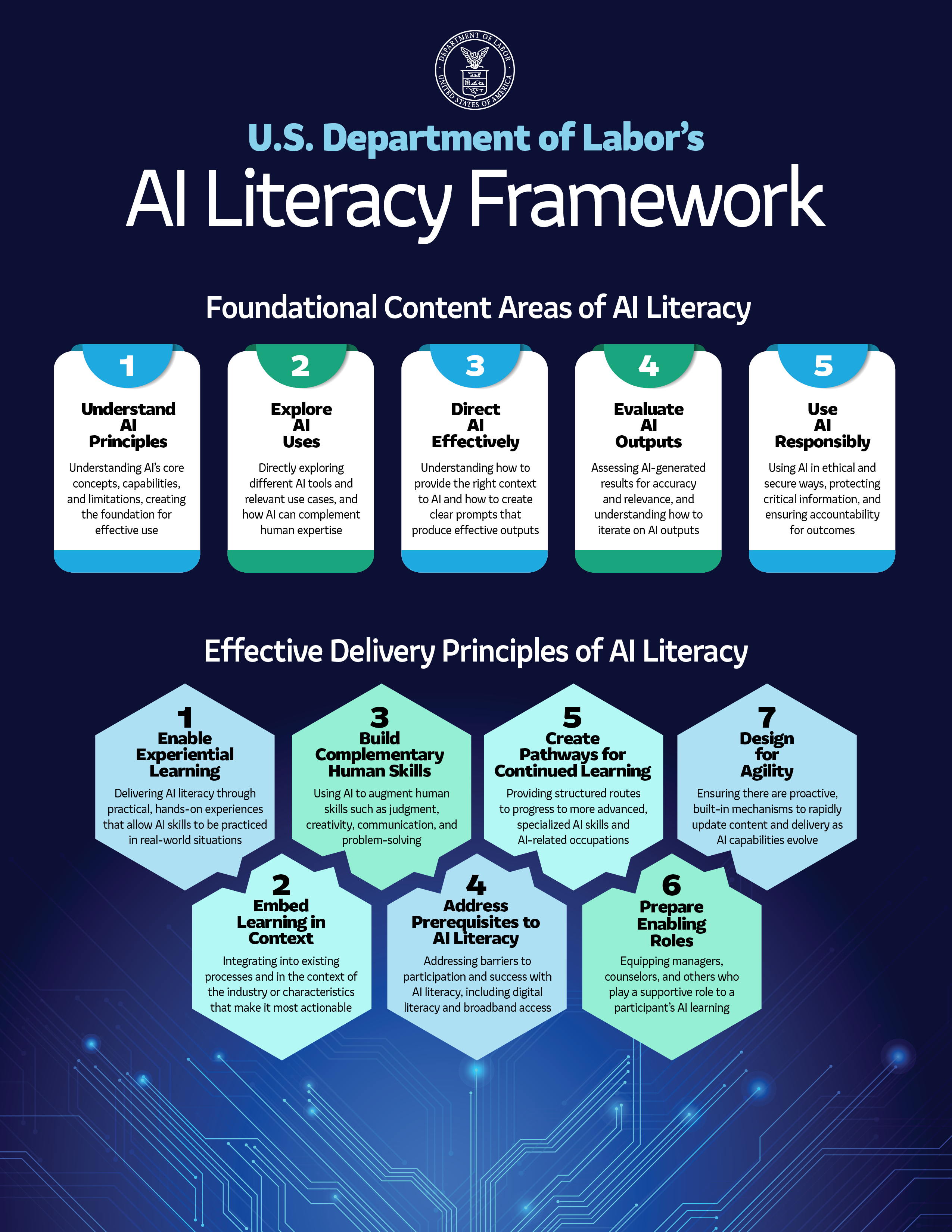
- US Department of Labor releases AI literacy framework providing foundational content areas, delivery principles to guide nationwide efforts
- AI Literacy Framework
- AI Literacy in Teaching and Learning: A Durable Framework for Higher Education
- Build AI knowledge and literacy
- AI Literacy, Explained
- Using AI Wisely as an Adult Learner: A Tool, Not a Shortcut
- Urgent Need for AI Literacy
- AI literacy: Closing the artificial intelligence skills gap
- Redefine AI upskilling as a change imperative
- Learn essential AI skills
- Upskilling and reskilling for talent transformation in the era of AI
- Navigating the tech talent shortage
- About 1 in 5 U.S. workers now use AI in their job, up since last year
- Despite worker upskilling, few employers hiring for AI skills: report
- AI linked to a fourfold increase in productivity growth and 56% wage premium, while jobs grow even in the most easily automated roles
- The No. 1 Skill Employers Want In 2025 And Most Job Seekers Don’t List It
- Top hard and soft skills each of our Divisions search for
Related Resources
-
![Business leaders reviewing workforce planning reports, labor market data, and staffing strategy analytics during a contingent workforce planning meeting for 2027.]()
Building a Winning Contingent Labor Strategy for 2027
Helping your program move from reactive to ready
-
![]()
-
![]()