Employers and candidates are often on opposing sides when it comes to workplace flexibility, but there are strategies to help both meet in the middle.
Strategies to help you win the battle for workplace flexibility

 Back to Top
While employers and candidates may differ on workplace flexibility, those differences don’t have to create friction. Clear strategies can help bridge the gap and align expectations.
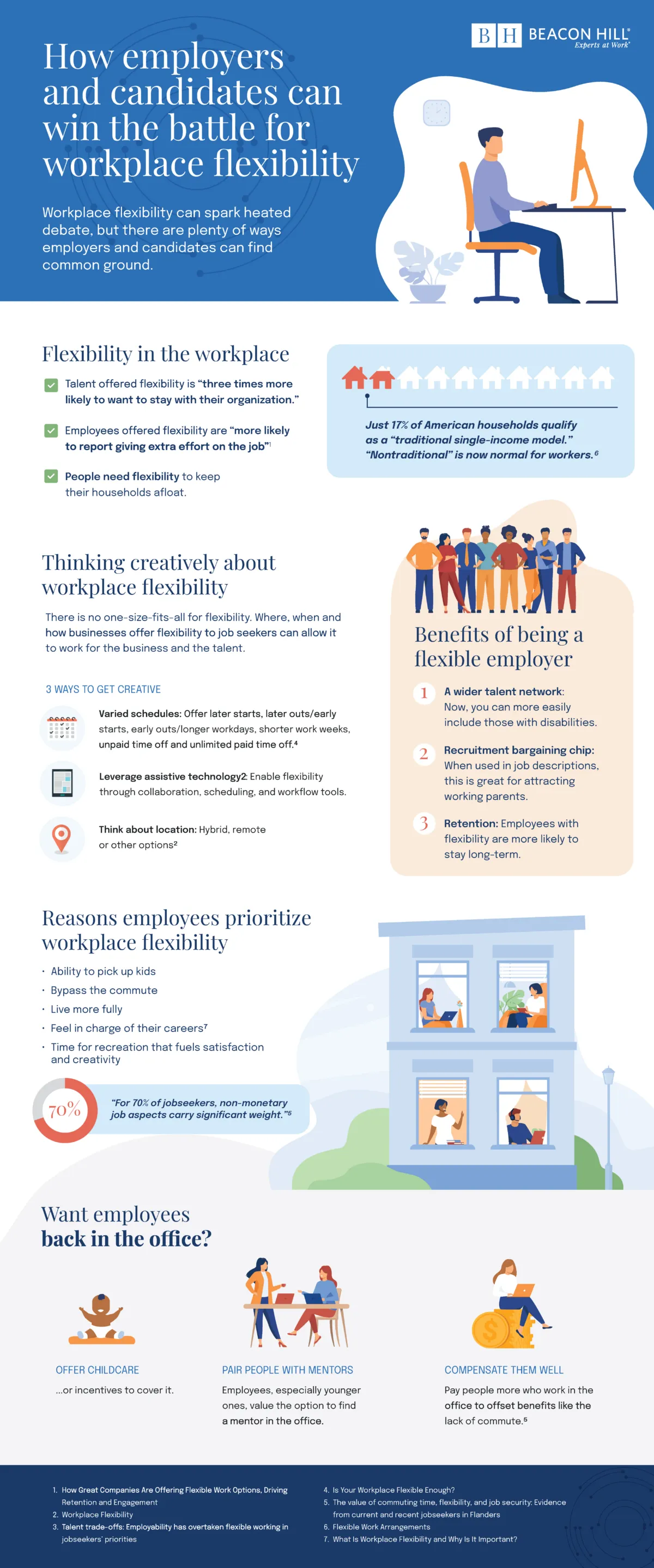
Short on time? Much of this article is covered in our infographic.
Flexibility in the workplace metrics
Keeping people in the long term is a struggle at the best of times, but one way to get them to stay is to be flexible! Did you know that talent offered flexibility is "three times more likely to want to stay with their organization"1?
Is your workforce lagging behind? Lacking in drive? They'll put in more effort1 in exchange for flexibility, too!
The truth is, many people need flexibility to keep their households afloat. Just 17% of American households qualify as a "traditional single‑income model." "Nontraditional" is now normal for workers.6 Due to this fact, agile employers win out over ones who can't offer fluidity.
Think creatively about workplace flexibility
There is no one-size-fits-all for flexibility. It's essential for businesses to consider where, when and how they can offer flexibility to job seekers. Equally important is a job seeker's ability to know what is reasonable to ask for. Transparency works for businesses and talent. Here are some areas that can be malleable.
Employ smart scheduling
Offer or ask to start the day later in exchange for leaving later, begin the day earlier to leave earlier or work a shorter work week with longer daily hours. You can also consider unpaid time off without consequences and possibly unlimited paid time off).4
Utilize assistive technology2
Determine what is needed to do the job, where the job needs to get done, to create a better situation for all. This is particularly attractive for disabled talent, as this technology can level the playing field for them.
Pro tip: You can enable flexibility through collaboration, scheduling, and workflow tools.
Consider location
Hybrid, remote2, or some combination of less traditional ideas can work well for many businesses and candidates.
Benefits of being a flexible employer
- A wider talent network–Increasing the size of your pool allows you to more easily tap into the power of working parents, especially working mothers, and those with disabilities.
- Recruitment bargaining–Including this "chip" in job descriptions is extremely attractive, increasing the pipeline and improving hire rates.
- Retention–Supporting a current team with flexibility can keep the best talent in-house.
Reasons employees prioritize workplace flexibility
For 70% of job seekers, non-monetary job aspects carry significant weight."5
Talent cares about flexibility for lots of reasons, like the ability to pick up kids, bypass the commute, feel in charge of the course of their careers7 and overall, live their lives more fully and have time for recreation that fuels satisfaction and creativity.
Returning to the office
Employers want employees back in the office, and while it feels hard to achieve, it's not impossible. Employees will definitely be more interested in returning in exchange for ...
- Childcare– ... or incentives to cover it.
- Mentoring opportunities–Employees, especially younger ones, value the option to find a mentor in the office.
- The right compensation–Pay people more who work in the office to offset benefits like the lack of commute.5
"Our recent survey of more than 5,000 workers across seven countries highlights this shift. When asked to weigh employability – staying relevant, skilled and secure – against remote work, 67% prioritized employability. Similarly, 52% placed greater value on skilling and training opportunities than on working remotely, and 59% said staying employable was even more important than having an exciting or inspiring role."3
It should also be noted that the economy has begun to favor employers again. While a long-term strategy would be to retain flexible offerings, employers may be in for a flood of candidates if businesses can demonstrate long-term employability for minimized stress.3
Beacon Hill specializes in finding mutually beneficial matches for employers and job seekers. Find yours!
Sources and inspiration
- How Great Companies Are Offering Flexible Work Options, Driving Retention and Engagement
- Workplace Flexibility
- Talent trade-offs: Employability has overtaken flexible working in jobseekers’ priorities
- Is Your Workplace Flexible Enough?
- The value of commuting time, flexibility, and job security: Evidence from current and recent jobseekers in Flanders
- Flexible Work Arrangements
- What Is Workplace Flexibility and Why Is It Important?
Related Resources
-
![]()
-
![Watercolor illustration of regulatory compliance, talent acquisition and pharmaceutical manufacturing operations featuring candidate screening, quality assurance checklists, production automation, manufacturing facilities and workforce planning for a radiopharmaceutical manufacturer.]()
Regulatory and Manufacturing Talent Support for a Global Radiopharmaceutical Manufacturer
Beacon Hill helped a global radiopharmaceutical manufacturer access specialized life sciences talent across regulated manufacturing, quality, validation and regulatory functions, supporting critical workstreams through contract placements, direct hires and consultant-to-FTE conversions.
-
![]()